
Wisdom Teeth Removal

Oral Examination for Extraction of Wisdom Teeth

With an oral examination and x-rays of the mouth, Dr. KimDr. WahanDr. Brady and Dr. Altmann can evaluate the position of the wisdom teeth and predict if there are present or future potential problems. Studies have shown that early evaluation and treatment result in a superior outcome for the patient. Patients are generally first evaluated in the mid-teenage years by their dentist, orthodontist, or by an oral and maxillofacial surgeon.

All outpatient surgery is performed under appropriate anesthesia to maximize patient comfort. Our doctors are trained, licensed, and highly experienced in providing various types of anesthesia for patients.

See the Wisdom Teeth Removal process.

Why should I have my wisdom teeth removed?

If you do not have enough room in your mouth for your third molars to fully erupt, a number of problems can happen. Impacted wisdom teeth should be removed before their root structure is fully developed. In some patients it is as early as 12 or 13, and in others it may not be until the early twenties. Problems tend to occur with increasing frequency after the age of 30. Some of the possible problems related to not removing your wisdom teeth include:

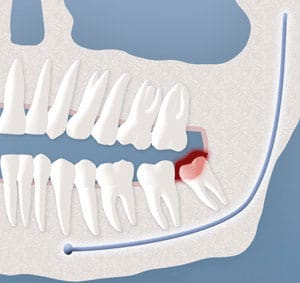
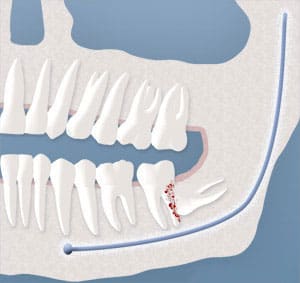
A representation of a pericoronitis infection on a wisdom tooth

Infection

The most frequent clinical problem we see is pericoronitis, (a localized gum infection). Without enough room for total eruption, the gum tissue around the wisdom tooth can become irritated and infected, resulting in recurrent pain, swelling, and problems with chewing and/or swallowing.
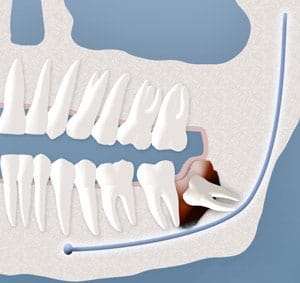
An example of a cyst formation on a wisdom tooth

Cyst Formation

Non-infectious diseases may also arise in association with an impacted wisdom tooth. Cysts are fluid-filled “balloons” inside the jaw bone that develop as a result of impacted teeth and slowly expand destroying adjacent jaw bone and occasionally teeth. They can be very difficult to treat if your wisdom teeth are not removed in your teenage years. Although rare, tumors can be associated with the delayed removal of wisdom teeth.
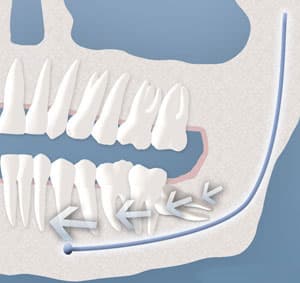
An illustration of teeth crowding caused by a wisdom tooth

Possible Crowding

Impacted wisdom teeth may contribute to crowding of your teeth. This is most noticeable with the front teeth, primarily the lower front teeth and is most commonly seen after a patient has had braces. There are a number of factors that cause teeth to crowd after braces or in early adulthood. Retained, impacted wisdom teeth may be a contributing factor. Unless you have an active problem when you see the oral surgeon, the reason for removal is primarily to prevent long-term damage to your teeth, gums and jaw bone.
A visual of a wisdom tooth damaging an adjacent tooth

Damage to Adjacent Teeth

If there is inadequate room to clean around the wisdom tooth, the tooth directly in front, the second molar, can be adversely affected resulting in gum disease, bone loss around the tooth, and/or decay.

What if I don’t have my wisdom teeth removed as a teenager or young adult?

As wisdom teeth develop, the roots become longer and the jaw bone more dense. When it is necessary to remove impacted wisdom teeth in your thirties, forties or beyond, the post-operative course can be prolonged and there is a higher complication rate. Treating these complications is often more difficult and less predictable than with a younger patient. Healing may be slower and the chance of infection can be increased. If your impacted wisdom teeth are not removed in your teenage years or early in your twenties and they are completely impacted in bone, it may be advisable to wait until a localized problem (such as cyst formation or localized gum disease and bone loss) develops. In general, you will heal faster, more predictably and have fewer complications if treated in your teens or early twenties.

What happens on the day wisdom teeth are removed?

Most people prefer to be unaware of the experience when they have their wisdom teeth removed and usually decide to be sedated. You will be provided with appropriate anesthesia options at your consultation. All outpatient surgery is performed under appropriate anesthesia to maximize your comfort. Our office staff has the training, licensing, and experience to provide the various types of anesthesia. These services are provided in an environment of optimum safety, utilizing modern monitoring equipment and a well trained experienced staff. The Surgical Care Team, the office facilities, and the doctors are inspected on behalf of the Board of Dental Examiners on a regular basis.

On the day of your procedure, you will take medications to help minimize post-operative pain and swelling. We ask that a parent or responsible adult accompanies you to the office and plans to stay with you the rest of the day. The procedure will take about 30 to 60 minutes and you will probably be in the office for 90 minutes. Recent advances in medicine and technology allow patients to undergo wisdom tooth removal in a manner, which promotes rapid healing and minimal post-operative discomfort. State-of-the-art sterilization and infection control techniques are used at all times.

On the morning or afternoon of your surgery, it is essential that you have nothing to eat or drink (excluding prescription medications with a sip of water) for at least 8 hours . This does not mean you should try to fit in one “last meal” exactly eight hours before your surgery. Having anything in your stomach can increase the risk for serious anesthetic complications, including nausea and vomiting. Your procedure will be rescheduled if you have not heeded these guidelines. When you are seated in the surgical room, we will make every effort to make you as comfortable as possible. If you are going to be sedated, we usually will place an IV in your left arm. This is a quick and nearly painless procedure that ensures optimal delivery of your medication. Local anesthesia is given to you afterwards to ensure comfort, and allow adequate time to travel home and rest. You will be sleepy for a significant portion of the day.

If your surgery requires stitches, these are usually the type that dissolve in 3 to 5 days and do not require removal. You may also notice a sensation of your gums feeling swollen and pulling away from your teeth. This is all part of the normal recovery, and will subside in several days.

Once the local anesthesia wears off, you may require prescription pain medication. Please try non-narcotic anti-inflammatory medications such as ibuprofen (Advil®) first, to see if that adequately treats your pain. If not, begin your other prescription pain medication. The local anesthesia may last until the following day, and should not be confused with an injury to your nerve. We recommend starting your post-operative diet with clear liquids such as jello and broths, gradually increasing in substance as your body permits.

We recommend using dairy products such as yogurt, ice cream or milkshakes on the day of surgery, as nausea and vomiting may develop in conjunction with the anesthetic and pain medication. If you are given antibiotics and you take birth control pills, please be aware that the birth control pills might become ineffective and take appropriate precautions.

~ Find Out if Dental Implants Are Right for You ~

smiling teenage son with his mother

The Day of Treatment

Be sure to have an adult with you at the time of removal. Make plans to have a parent or responsible adult stay with you for the rest of the day, following wisdom tooth removal.

A smiling woman

The Day of Treatment

Please do not eat or drink anything prior to your surgery. Having anything in your stomach can increase the risk for serious anesthetic complications.

What does wisdom tooth removal cost and is it covered by insurance?

The fee for your treatment is determined by a number of factors. These may include the difficulty involved in removing your teeth and which type of anesthesia is best for you. During your consultation appointment, the surgeon will need to review your x-rays, complete an examination and determine the best option for anesthesia, before an accurate estimate can be provided. Every insurance company has a different policy regarding the extent of coverage for a given surgical procedure. The oral surgeon’s office staff will help you obtain maximum insurance coverage for your treatment.

What if I have questions before surgery?

At the time of your consultation, your specific situation will be discussed in greater detail. We encourage you to ask any questions you may have. If new questions arise after your consultation, please call our office at 425-743-0227 to speak to one of our patient care coordinators.

Oral, Facial, and Dental Surgery Services

Surgeons Peter H. Kim, DDS; Serv S. Wahan, DMD, MD; Daniel T. Brady, DDS; and Dustin Altmann, DMD, Michael Gross, DMD, MD, provide a full scope of oral and maxillofacial surgery, from corrective jaw surgery and wisdom tooth removal to advanced dental implant and bone grafting procedures, as well as diagnosis and treatment of facial pain, facial injuries, and TMJ disorders. Our clinical team is highly trained in assisting with I.V. sedation in a modern, state-of-the-art office setting, so you can receive care comfortably and safely.
Surgeons Peter H. Kim, DDS; Serv S. Wahan, DMD, MD; Daniel T. Brady, DDS; and Dustin Altmann, DMD, provide a full scope of oral and maxillofacial surgery, from corrective jaw surgery and wisdom tooth removal to advanced dental implant and bone grafting procedures, as well as diagnosis and treatment of facial pain, facial injuries, and TMJ disorders. Our clinical team is highly trained in assisting with I.V. sedation in a modern, state-of-the-art office setting, so you can receive care comfortably and safely.
Dental Implants
Bone Grafting
Wisdom Teeth
Impacted Teeth
Facial Trauma
Tooth Extractions
Oral Pathology
Bone Growth Protein
3D Imaging
Anesthesia
Pre-Prosthetic Surgery
~ We are currently accepting new patients ~

Board-Certified Oral & Maxillofacial Surgeons in Washington State

What Our Patients’ Say

FAQs

How do dentists know when wisdom teeth should be removed?

Wisdom teeth are evaluated through exams and imaging to see how they are positioned and whether there is enough room for them to function properly. Removal is usually recommended when the teeth are impacted, growing at an angle, or creating pressure on nearby teeth or bone.

Yes. Wisdom teeth can create issues without causing immediate pain. They may trap bacteria, damage nearby teeth, or affect jawbone health over time, which is why monitoring or early removal is sometimes advised.

When wisdom teeth do not erupt normally, they can contribute to infection, cyst formation, crowding, or bone damage. These problems may become more difficult to treat if addressed later rather than earlier.

Yes. Impacted wisdom teeth require a more involved approach because they are trapped beneath the gums or bone. The procedure is planned carefully to remove the tooth while protecting surrounding structures.

Removal is carefully planned to avoid damage to nearby teeth and bone. In many cases, removing problematic wisdom teeth helps protect surrounding teeth and maintain better long-term oral stability.

Not always. While many people have wisdom teeth removed earlier, removal may still be recommended later if problems develop. The decision is based on current oral health, tooth position, and risk factors rather than age alone.

Scroll to Top