
Sinus Lift
What is a sinus lift?
The maxillary sinuses are behind your cheeks and on top of the upper teeth. These sinuses are empty, air-filled spaces. Some of the roots of the natural upper teeth extend up into the maxillary sinuses. When these upper teeth are removed there is often just a thin wall of bone separating the maxillary sinus and the mouth. Dental implants need bone to hold them in place. When the sinus wall is very thin, it is impossible to place dental implants in this bone.
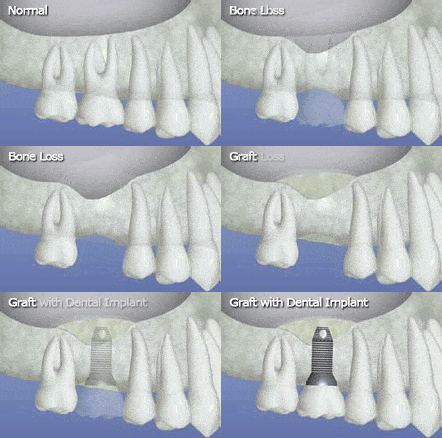
The key to a successful and long-lasting dental implant is the quality and quantity of jaw bone to which the implant will be attached. If bone loss has occurred due to injury or periodontal disease, a sinus augmentation can raise the sinus floor and allow for new bone formation. A sinus lift is one of the most common bone grafting procedures for patients with bone loss in the upper jaw. The procedure seeks to grow bone in the floor of the maxillary sinus above the bony ridge of the gum line that anchors the teeth in the upper jaw. This enables dental implants to be placed and secured in the new bone growth.
Am I a candidate for a sinus lift procedure?
A sinus lift may be necessary if you:
- are missing more than one tooth in the back of your jaw
- are missing a significant amount of bone in the back of your jaw
- are missing teeth due to a birth defect or condition
- are missing most of the maxillary teeth and require support for dental implants
How is a sinus lift accomplished?
Most commonly, a small incision is made on the premolar or molar region to expose the jaw bone. A small opening is cut into the bone, and the membrane lining the sinus is pushed upward. The underlying space is filled with bone grafting material, either from your own body or from a other sources. Sometimes, synthetic materials that imitate bone formation are used. After the bone is implanted, the incision is sutured and the healing process begins. After several months of healing, the bone becomes part of the patient’s jaw and dental implants can be inserted and stabilized in the newly formed sinus bone.
If enough bone between the upper jaw ridge and the bottom of the sinus is available to sufficiently stabilize the implant, sinus augmentations and implant placement can sometimes be performed as a single procedure. If not enough bone is available, the sinus augmentation will have to be performed first, then the graft will have to mature for up to several months, depending upon the type of graft material used. Once the graft has matured, the implants can be placed.
The sinus graft makes it possible for many patients to have dental implants that previously had no other option besides wearing loose dentures.
A sinus augmentation is generally performed at Dr. Kim, Dr. Wahan, Dr. Brady and Dr. Altmann‘s office, under local anesthesia. Some patients may request oral or intravenous sedative medication as well.
~ Find Out if Dental Implants Are Right for You ~
Oral, Facial, and Dental Surgery Services
Board-Certified Oral & Maxillofacial Surgeons in Washington State
- Board-Certified Specialists
- Trusted by Referring Dentists
- State-of-the-Art Technology
- Proven Outcomes & Satisfaction
- Personalized Patient Experience
- Comprehensive Care
- Advanced Surgical Expertise
- Safe Sedation
- Four Local Offices
What Our Patients’ Say
Dr. Kim and the whole staff are as good as they get. Fast and efficient, they work together like a swiss watch. Great follow up. Knowledgeable staff. I would highly recommend that you give them a try if you are looking for the best option for your dental needs.
5 stars all the way. I’d give them 10 stars if I could!!!! Mark D. / Seattle, WA
Mark D. / Seattle, WA
Dr. Kim and the whole staff are as good as they get. Fast and efficient, they work together like a swiss watch. Great follow up. Knowledgeable staff. I would highly recommend that you give them a try if you are looking for the best option for your dental needs.
5 stars all the way. I’d give them 10 stars if I could!!!! Mark D. / Seattle, WA
Mark D. / Seattle, WA
Dr. Kim and the whole staff are as good as they get. Fast and efficient, they work together like a swiss watch. Great follow up. Knowledgeable staff. I would highly recommend that you give them a try if you are looking for the best option for your dental needs.
5 stars all the way. I’d give them 10 stars if I could!!!! Mark D. / Seattle, WA
Mark D. / Seattle, WA
FAQs
Why does the sinus matter when placing upper dental implants?
The sinus sits just above the upper back teeth. When those teeth are missing, the bone underneath can thin over time, leaving less support for an implant. A sinus lift helps create enough space and bone structure so an implant can be placed safely.
Is a sinus lift only needed for back upper teeth?
Yes. Sinus lift procedures are typically associated with the upper molars and premolars because of their close position to the sinus cavity. Implants in other areas of the mouth usually don’t involve the sinus.
Can a sinus lift and dental implant be done at the same time?
In some cases, yes, but not always. It depends on how much existing bone is present and how stable an implant would be at placement. Your surgeon will determine the safest approach during your evaluation.
Will having sinus issues or allergies affect my ability to get a sinus lift?
Sinus health is an important part of the evaluation. A history of sinus problems doesn’t automatically rule out treatment, but it may influence timing or planning. Your surgeon will review your medical history carefully before moving forward.
Is a sinus lift considered a common procedure?
Yes. Sinus lifts are a well-established bone grafting procedure and are frequently used to help patients qualify for upper dental implants when bone height is limited.
What should I expect after a sinus lift procedure?
After the procedure, the area is given time to heal and stabilize. Follow-up visits allow your surgeon to monitor healing and determine when it’s appropriate to move to the next phase of treatment, such as implant placement.