
Bone Grafting for Implants
Do I have enough bone for dental implants?
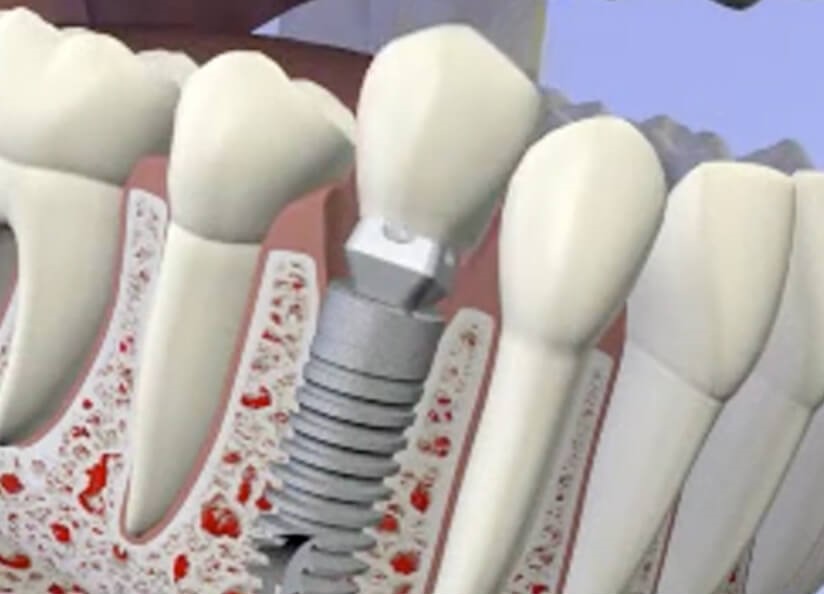
Bone Grafting for Implants
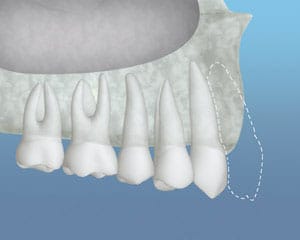
1 / Inadequate Bone
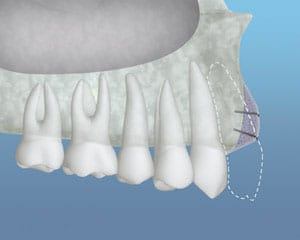
2 / Graft Material Placed

3 / Implants Placed
1 / Inadequate Bone
2 / Graft Material Placed
3 / Implants Placed
There may be inadequate bone for implant placement if your tooth was removed many years ago and your bony ridge is extremely thin. In this case, a bone graft can be placed next to the thin bone and allowed to heal for up to six months. After the graft has fused to your pre-existing bone, the ridge will be re-entered and the implant placed. Bone grafting is usually a relatively comfortable office procedure. Many different bone-grafting materials are available, including your own bone.
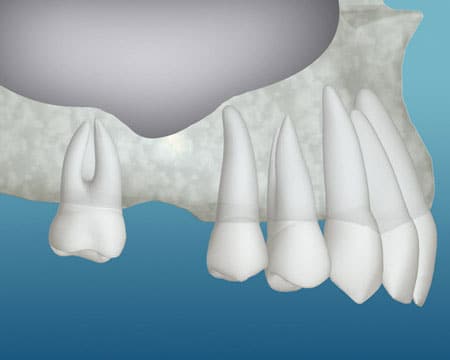
1 / Inadequate Bone
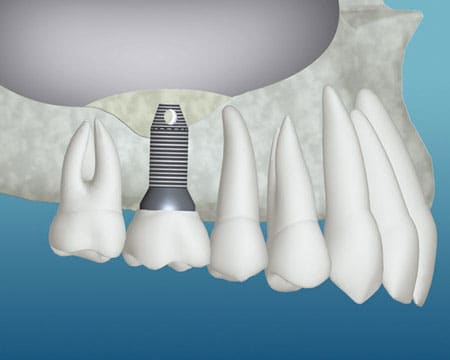
2 / Graft Material and Implant Placed
1 / Inadequate Bone
2 / Graft Material and Implant Placed
You may also need bone grafting if the sinus cavities in your upper jaw are very large, or very low, and extend into the tooth-bearing areas. This often occurs when teeth in the back of a person’s upper jaw have been removed many years before, and the amount of bone available for implant placement is limited. A “sinus grafting procedure” is then required. Most often, it is performed in the office with local anesthesia and perhaps sedation. During this procedure, the membrane that lines the sinus will be located and elevated. Bone will then be added to restore the bone height and ensure that dental implants of an adequate length can be placed. This procedure often can be performed at the time of implant placement.
Healing after Dental Implant Surgery
Now the healing begins. The length of time varies from person to person, depending upon the quality and quantity of bone. In some cases, implants may be restored immediately after they are placed. The surgeon will advise you on follow-up care and timing. After the initial phase of healing, the surgeon places an abutment (support post) or a healing cap onto the dental implant during a brief follow-up visit. This allows gum tissue to mature and provides access to the implant.
Occasionally, impressions are made at the time the implant is placed. This enables the crown to be ready when the implants have healed. How long your mouth needs to heal is determined by a variety of factors. Follow-up care (one to four appointments) is usually needed to ensure that your mouth is healing well and to determine when you are ready for the restorative phase of your treatment.
It may be beneficial to perform a soft tissue graft to obtain stronger, more easily cleaned and natural appearing gum tissue in the area around the implant. This process involves moving a small amount of gum tissue from one part of your mouth to the area around the implant. Most often, it is a brief and relatively comfortable procedure.
Whether it’s one tooth or all of your teeth that are being replaced, your dentist will complete the restoration by fitting the replacement tooth (crown) to the dental implant.
~ Find Out if Dental Implants Are Right for You ~
When are Dental Implants Placed?
Implants are often placed several months after extraction. At times, an implant may be placed immediately after extraction of a tooth. This may involve a little more risk, but it simplifies the process—you won’t have to wait for another appointment to place the implant. When infection or other problems with the bone are present, immediate implant placement is not the best treatment. If your tooth has been missing for some time, the adjacent support bone is likely to grow thinner and shrink. This occurs because the root of the natural tooth has to be present to stimulate the bone. As much as one third of your jaw’s thickness can be lost in the year following tooth extraction. If you are missing enough bone, you may benefit from having additional bone grafted into the area. This ensures the implant will be adequately supported when it is placed in the jaw.
How Many Implants Do I Need?
Most frequently, one implant per missing tooth is placed. Because many of the larger teeth in the back of your jaws have two or three roots, the most common approach is to replace missing back teeth with larger implants.
Oral, Facial, and Dental Surgery Services
Board-Certified Oral & Maxillofacial Surgeons in Washington State
- Board-Certified Specialists
- Trusted by Referring Dentists
- State-of-the-Art Technology
- Proven Outcomes & Satisfaction
- Personalized Patient Experience
- Comprehensive Care
- Advanced Surgical Expertise
- Safe Sedation
- Four Local Offices
What Our Patients’ Say
Dr. Kim and the whole staff are as good as they get. Fast and efficient, they work together like a swiss watch. Great follow up. Knowledgeable staff. I would highly recommend that you give them a try if you are looking for the best option for your dental needs.
5 stars all the way. I’d give them 10 stars if I could!!!! Mark D. / Seattle, WA
Mark D. / Seattle, WA
Dr. Kim and the whole staff are as good as they get. Fast and efficient, they work together like a swiss watch. Great follow up. Knowledgeable staff. I would highly recommend that you give them a try if you are looking for the best option for your dental needs.
5 stars all the way. I’d give them 10 stars if I could!!!! Mark D. / Seattle, WA
Mark D. / Seattle, WA
Dr. Kim and the whole staff are as good as they get. Fast and efficient, they work together like a swiss watch. Great follow up. Knowledgeable staff. I would highly recommend that you give them a try if you are looking for the best option for your dental needs.
5 stars all the way. I’d give them 10 stars if I could!!!! Mark D. / Seattle, WA
Mark D. / Seattle, WA
FAQs
What does it mean when a dentist says there isn’t enough bone for implants?
This usually means the jawbone has thinned or shrunk in the area where an implant would be placed. Bone loss can happen after a tooth has been missing for some time or due to gum disease. Bone grafting is used to rebuild that area so an implant has proper support.
Does needing a bone graft mean dental implants aren’t an option?
No. Being told a bone graft is needed does not automatically rule out dental implants. In many cases, bone grafting is performed specifically to make implant placement possible when bone levels are too low.
How is bone loss in the jaw diagnosed?
Bone loss is identified using dental imaging, such as 3D scans or X-rays. These images allow the surgeon to measure bone height and width and determine whether additional bone support is needed before placing an implant.
Is bone grafting always a separate procedure?
Not always. In some situations, bone grafting can be done at the same time as implant placement. In other cases, grafting is completed first, followed by a healing period. The decision depends on how much bone is needed and where the implant will be placed.
Where does the bone graft material come from?
Bone graft material can come from different sources, depending on the clinical situation. The type of graft used is selected based on the size of the area being treated and the surgeon’s treatment plan. This is reviewed during the consultation.
What happens if bone grafting is not done when it’s recommended?
Without adequate bone support, dental implants may not be stable or successful long term. Bone grafting is recommended to improve implant support and reduce the risk of complications related to insufficient bone.