
Dental Implants in Everett & Snohomish County, WA
Placed by board-certified oral and maxillofacial surgeons at four offices: Everett, Mill Creek, Snohomish and Smokey Point.
What are dental implants?
A natural tooth consists of a root and a crown. If you compare natural teeth to implant-supported replacement teeth, you’ll see they have the same basic parts. Both have a crown (the visible part used to chew food). Both have a root that holds the tooth securely under the gum and is anchored into the jaw. The difference is that the implant is made of titanium – the same time-tested material used by surgeons for artificial joints. When you lose a tooth, you lose both the root and the crown. To replace the tooth, the surgeon first replaces the root with a small dental implant.
Time is allowed for bone to heal and grow around the dental implant. The bone bonds with the titanium, creating a strong foundation for artificial teeth. A support post (abutment) is then placed on the implant and a new replacement tooth (crown) is placed on top of the abutment. In many cases a temporary replacement tooth can be attached to the implant immediately after it is placed. If all of your teeth are missing, a variety of treatment options are available to support the replacement teeth.
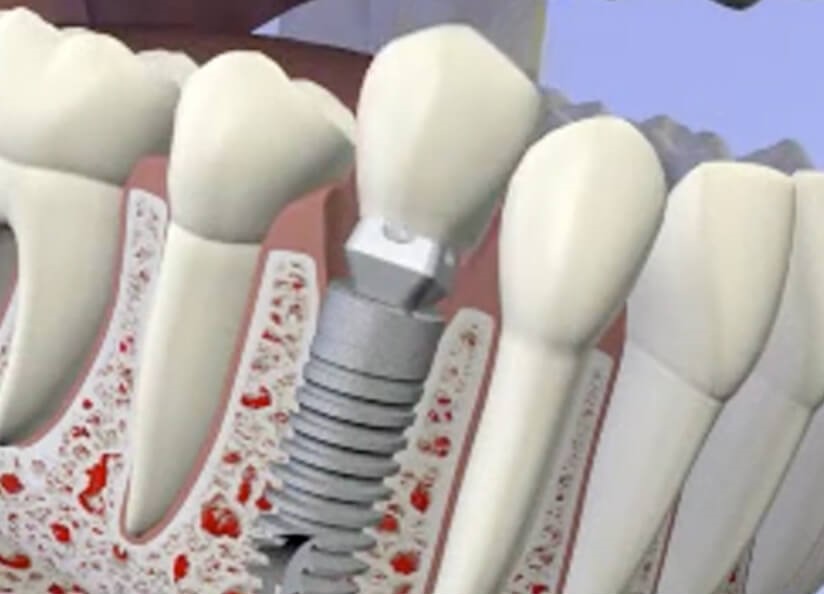
See the dental implant process.

“Don’t be afraid to Smile.”
For years I’d felt like a part of my body was missing — because my teeth were. My dentist told me that dental implants would make me feel and look a lot better. OK, I said. Now, I’m thrilled. I can smile, eat anything, and enjoy a good laugh with my friends.
Surgical Advances in Dental Implants
Using the most recent advances in dental implant technology, Dr. Kim, Dr. Wahan, Dr. Brady, Dr. Altmann and Dr. Gross are able to place single stage implants. These implants do not require a second procedure to uncover them, but do require a minimum of six weeks of healing time before artificial teeth are placed. There are even situations where the implant can be placed at the same time as the tooth extraction – further minimizing your number of surgical procedures.
Dental implant placement is a team effort between an oral and maxillofacial surgeon and a restorative dentist. Drs. Kim, Wahan, Brady, Altmann and Gross performs the actual implant surgery, initial tooth extractions, and bone grafting if necessary. The restorative dentist (your dentist) fits and makes the permanent prosthesis. Your dentist will also make any temporary prosthesis needed during the implant process.
Oral, Facial, and Dental Surgery Services
Board-Certified Oral & Maxillofacial Surgeons in Washington State
- Board-Certified Specialists
- Trusted by Referring Dentists
- State-of-the-Art Technology
- Proven Outcomes & Satisfaction
- Personalized Patient Experience
- Comprehensive Care
- Advanced Surgical Expertise
- Safe Sedation
- Four Local Offices
What Our Patients’ Say
Dr. Kim and the whole staff are as good as they get. Fast and efficient, they work together like a swiss watch. Great follow up. Knowledgeable staff. I would highly recommend that you give them a try if you are looking for the best option for your dental needs.
5 stars all the way. I’d give them 10 stars if I could!!!! Mark D. / Seattle, WA
Mark D. / Seattle, WA
Dr. Kim and the whole staff are as good as they get. Fast and efficient, they work together like a swiss watch. Great follow up. Knowledgeable staff. I would highly recommend that you give them a try if you are looking for the best option for your dental needs.
5 stars all the way. I’d give them 10 stars if I could!!!! Mark D. / Seattle, WA
Mark D. / Seattle, WA
Dr. Kim and the whole staff are as good as they get. Fast and efficient, they work together like a swiss watch. Great follow up. Knowledgeable staff. I would highly recommend that you give them a try if you are looking for the best option for your dental needs.
5 stars all the way. I’d give them 10 stars if I could!!!! Mark D. / Seattle, WA
Mark D. / Seattle, WA
FAQs
How do dental implants replace a missing tooth?
Dental implants replace a missing tooth by placing a small post into the jawbone where the tooth root used to be. This post acts as a stable foundation, allowing a replacement tooth to be attached in a way that closely mimics how a natural tooth functions and feels.
How long does it take for a dental implant to bond with the jawbone?
After the implant is placed, the jawbone gradually grows around it in a process that helps secure the implant in place. This healing phase takes time and is an important step before the final tooth restoration is attached.
Can dental implants support more than one missing tooth?
Yes, dental implants can be used to replace a single tooth, multiple teeth, or even help support full-arch restorations. The number of implants and the treatment approach depend on how many teeth are missing and the condition of the jawbone.
Is dental implant placement considered a surgical procedure?
Dental implant placement is a surgical procedure performed by trained oral and maxillofacial surgeons. The procedure is carefully planned to ensure accuracy, comfort, and proper healing.
What happens if there is not enough bone for an implant?
If there is not enough bone to support an implant, additional procedures may be recommended to help create a stable foundation. This is evaluated during the consultation and imaging process to determine the safest and most effective treatment plan.
Why are dental implants considered a long-term tooth replacement option?
Dental implants are designed to function like natural tooth roots, providing strong support for replacement teeth. Because they are anchored in the jawbone, they offer stability and durability that many patients prefer when replacing missing teeth.